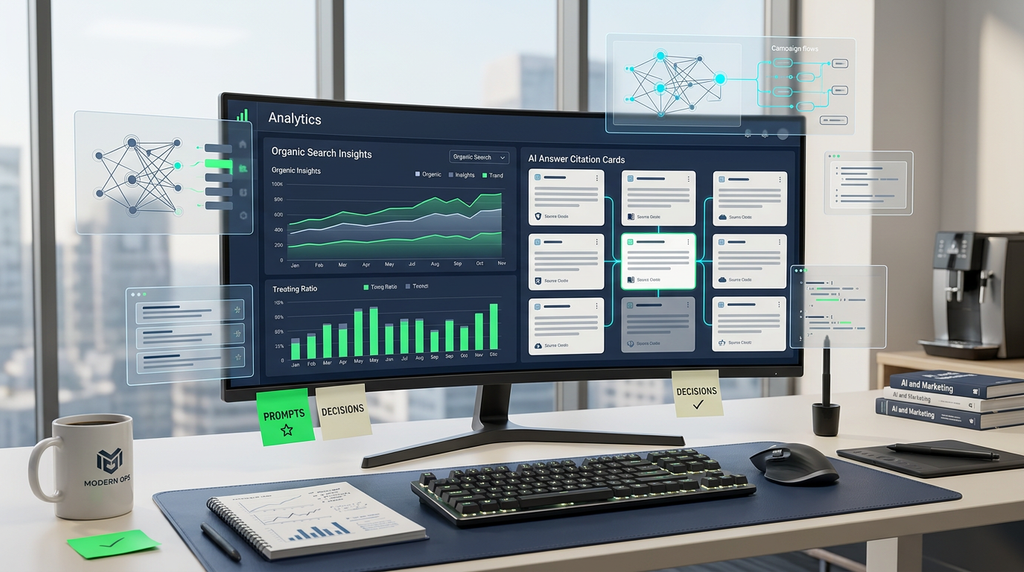
Why Are Our High-Traffic Product Pages Missing From AI Recommendations?
A composite product marketing team discovers that strong organic traffic does not guarantee inclusion in AI recommendations.
 Marketing Signal Journal
Practitioner stories from the AI marketing transition.
Share of Model is the percentage of AI-generated answers that cite or recommend a brand across a tracked set of prompts.
A composite product marketing team discovers that strong organic traffic does not guarantee inclusion in AI recommendations.
A first AI visibility report is often expected to provide a straightforward baseline, but it can uncover a backlog of unresolved decisions that complicate marketing operations.
A composite product marketing story about separating missing proof from missing AI brand visibility.
OpenAI's recent announcement about merging usage limits for ChatGPT and Codex presents a significant operational challenge for marketing teams.
A composite growth marketing director turns missing AI answers into a credible Markgrid budget request by tying buyer prompts, competitor citations, and prioritized fixes to lost evaluation opportunities.
An SEO-only Monday report can show traffic and rankings while missing whether AI answer engines recommend the brand.
Marketing teams can effectively run a 60-day AI visibility pilot using Markgrid by focusing on structured tracking of brand mentions in AI-generated answers.
The story of how an SEO lead and a brand lead unified their understanding of AI visibility exemplifies a common challenge in marketing teams.
AI visibility metrics initially promised clarity for an SEO team but quickly became a source of confusion and inefficiency.
OpenAI’s GPT-6.1 Terra announcement gives marketing teams a reason to recheck the AI answers buyers see.
A common challenge for modern marketing teams is adapting to the fast-evolving landscape of AI-driven search.
Recent price reductions in large language models (LLMs) from OpenAI and Anthropic have raised questions for marketers about the value of AI brand monitoring.
SEO reporting and AI visibility reporting serve different purposes, and marketing leaders must distinguish between them when addressing the board.
In the rapidly evolving landscape of digital marketing, startup teams must adopt a systematic approach to track their visibility in AI-generated answers.
In the fast-evolving landscape of marketing, understanding how generative AI influences decision-making is critical.
Apollo's recent findings indicate that there are currently no signs of AI payoff outside the tech sector, prompting marketing leaders to reconsider their AI strategies.
A composite brand team discovers that its internal positioning and AI-generated category narrative do not match.
Content leads often face overwhelming pressure to address every missed mention of their brand in AI answers.
Measuring AI visibility is crucial for modern marketing strategies.
Maya, a CMO at a mid-market B2B software company, faced a significant challenge: despite having a robust organic and paid program, she couldn't determine if her brand was effectively represented in AI-generated answers from models like ChatGPT and Gemini.
To effectively navigate AI-driven search landscapes, marketers must identify the buyer questions their competitors answer.
A composite brand-team story about moving from scattered AI screenshots to a disciplined process for updating core messaging.
A composite demand generation team story about choosing one AI visibility problem to fix instead of chasing every missing AI answer.
Many retail teams struggle to measure the effectiveness of traditional search campaigns alongside emerging AI discovery campaigns.